Guide
Emergency Binder Checklist: What to Include
If something happened to you tomorrow, could your family find what they need? An in-case-of-emergency binder is one organized place that answers that question: who to call, where the important papers are, how the bills get paid and what you would want. This checklist walks through what to put in it, section by section, so you can build one in an afternoon.
What an emergency binder is, and what it is not
An emergency binder (also called a life binder, a family emergency binder or an "if I die" binder) is a set of pages, printed or digital, that collects the practical facts of your life in one spot. It is a map, not a vault. It tells people where things are and who to call. It does not replace a will, a trust, a power of attorney or a healthcare directive, and it does not give anyone legal authority on its own.
It is just as useful for a hospital stay, a sudden trip or a relative stepping in to help for a few weeks as it is for the hardest case. You make it once, update it twice a year, and hope nobody needs it.
The one rule: write where, not what
Do not write passwords, PINs, full account numbers or your Social Security number in the binder. A binder can be lost, photographed or read by the wrong person. Write where things can be found instead: "Passwords are in my password manager, and the emergency kit is in the fireproof box in the hall closet." If you want to identify an account, use the last four digits only. A where-to-find note is safe, and it is just as helpful to the person reading it.
The checklist
Skip anything that does not apply to you. A binder that is mostly finished is far more useful than a perfect one that never gets done.
1. About you
- Full legal name, other names you have used, date and place of birth
- Home address, mobile phone and personal email
- Employer or occupation, and military service if any
- Where your Social Security card is kept (the location, never the number)
2. Who to call first
A short list of the people who should hear first and who can start helping right away: a spouse or partner, a sibling, a close friend, a neighbor. For each, write the name, relationship, phone number and what they can help with.
3. Key people and roles
The people you trust to act for you: executor or personal representative (and a backup), trustee, healthcare agent, financial power of attorney, guardian for minor children, pet caretaker, attorney, accountant and financial advisor. Fill in names even if the legal paperwork is not done yet. Seeing a blank next to "healthcare agent" is often the nudge to finish it.
4. Important documents and where they are
List each document, where the original is, who holds a copy and when you last updated it. Common items are your will, trust, powers of attorney, healthcare directive, birth and marriage certificates, divorce decree, passport, property deeds, vehicle titles, military discharge papers, recent tax returns, safe deposit box and spare keys. The full guide to documents your family should be able to find goes through them one by one.
5. Medical information
- Allergies, medical conditions and any implants or devices
- Medications with doses, doctors, pharmacy and preferred hospital
- Where your health insurance card is kept
- Organ donor status and whether a do-not-resuscitate order or POLST form exists, and where it is
These are details a caregiver would want quickly. They are not a medical record, so review them at least twice a year.
6. Money and insurance
- Bank and cash accounts: institution, type, last four digits, who is on the account
- Retirement and investment accounts, with who the beneficiary is
- Insurance: life, health, auto, home or renters, disability and long-term care, with the company, phone number and where the policy is kept
- Debts and credit cards, with approximate balances
- Bills and autopay: who you pay, how much, which day and from which account
7. Home, vehicles, property and pets
Whether you own or rent, who the landlord or mortgage servicer is, which utilities are in whose name, where spare keys are, and where to find the alarm or garage code (not the code itself). Add vehicles and where the titles are, storage units, and a one-page pet care sheet with the vet, food, medications and who has agreed to help.
8. Digital life
Most of a modern life lives on a phone or in the cloud. Note which password manager you use and how a trusted person could get in, where your recovery kit is kept, where to find your phone passcode, your main email and recovery email, cloud storage and photo backups, subscriptions that charge a card, social media wishes and any legacy contact you have set up with Apple, Google or Facebook.
9. Work and business
Your employer and HR contact, work benefits such as life insurance, and, if you run a business, who can access its accounts and which clients or projects need a handoff.
10. Final wishes and messages
Burial, cremation or another choice, any pre-arrangements, the kind of service you would like, music and readings, and anything you do not want. Many people also add a few lines to the people they love. Families often treasure that page most, and writing your wishes down spares them from guessing during a hard week.
11. A first-steps page for your family
A short, ordered list of what to do in the first days, so nobody has to work it out from scratch. You can use ours: What to do when someone dies: a first 72 hours checklist.
How to put it together in an afternoon
- Start with "who to call first" and "key people and roles." About fifteen minutes.
- List your documents and where they are.
- Add money, insurance, bills and autopay.
- Add your digital life and subscriptions.
- Finish with final wishes and messages. Take your time on this one, or come back to it another day.
Put the printed pages in a 3-ring binder with dividers, or keep them as a PDF. Either works.
Where to keep it, and who gets a copy
Keep the printed binder somewhere your trusted person can find without a hunt, such as a file cabinet or fireproof box, and make sure they know how to open it. If you keep a digital copy, protect it with a passphrase and share the passphrase separately, in person or by phone, never in the same message as the file. Avoid sending an unprotected copy by email.
Keep it current
Review it twice a year and after any big change: a move, a new job, a marriage or divorce, a birth, a new account or a death in the family. Write the date at the back so everyone knows how fresh it is.
Two ways to get started today
Free: Emergency Binder Lite covers five key sections in your browser. Print it or save it as a PDF. Nothing is uploaded.
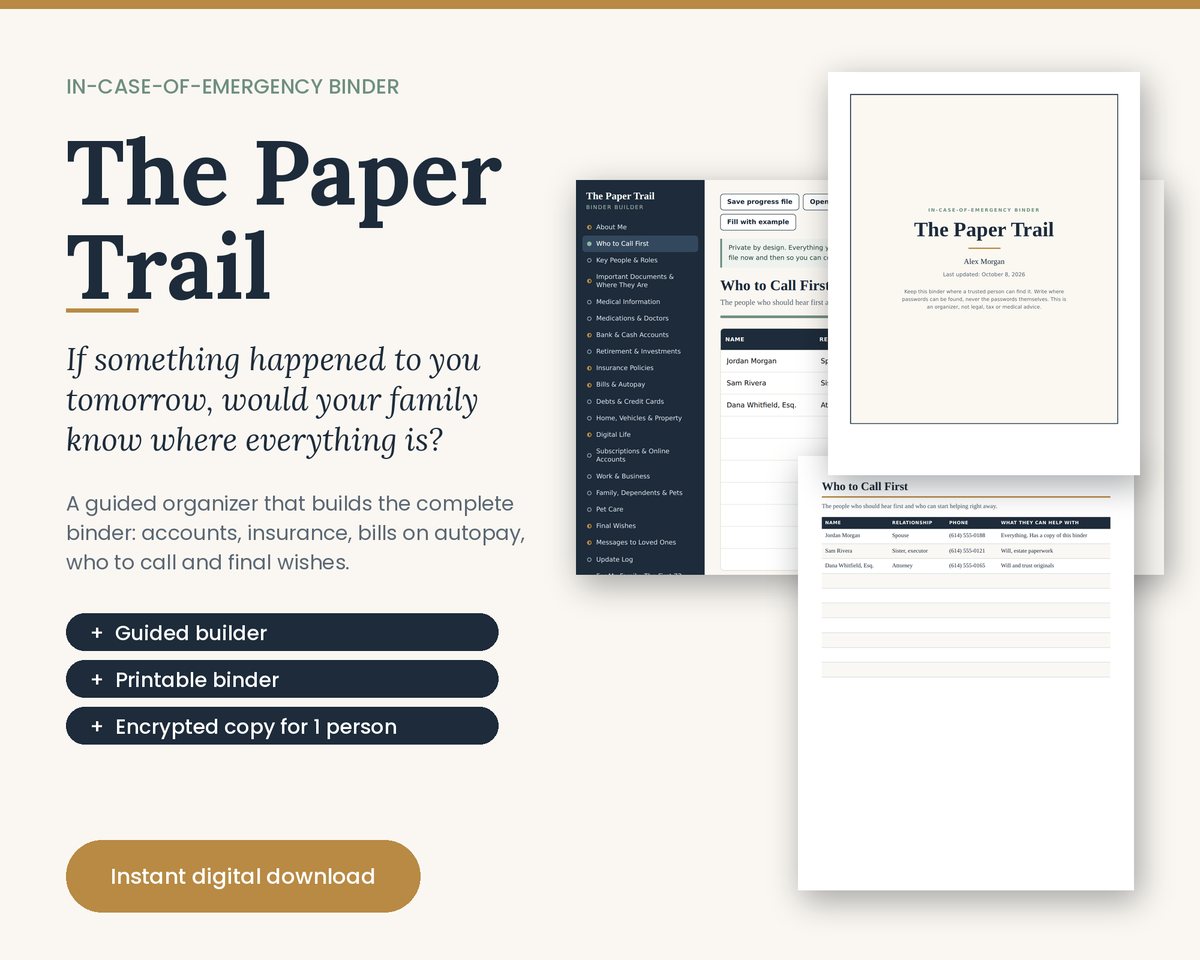
The full binder: The Paper Trail has all 22 sections, a guided builder, a 24-page printable PDF and an encrypted copy for one trusted person. $29 on Etsy, instant download.
Frequently asked questions
What should I put in an emergency binder first?
Start with who to call first and where your important documents are. Those two pages help most in the first hours of any emergency. Add medical information, insurance, accounts and your digital life next, and leave final wishes and personal messages for when you have time.
Should I write my passwords in an emergency binder?
No. Write where passwords and codes can be found, such as the name of your password manager and where its recovery kit is kept. A binder can be lost or read by the wrong person, so it should never contain the passwords themselves.
Where should I keep my emergency binder?
Somewhere a trusted person can find without searching, such as a file cabinet or fireproof box, and tell them where it is. If you keep a digital copy, protect it with a passphrase and share the passphrase separately, never in the same message as the file.
How often should I update it?
Review it twice a year and after any big change, such as a move, a new job, a marriage or divorce, a birth or a new account.
Is an emergency binder a substitute for a will?
No. A binder is an organizer that points to your legal documents. It does not replace a will, trust, power of attorney or healthcare directive. An attorney can help with those, and laws vary by state.
AuraByRobbie sells The Paper Trail on Etsy. This guide is general information, not legal, tax, financial or medical advice.